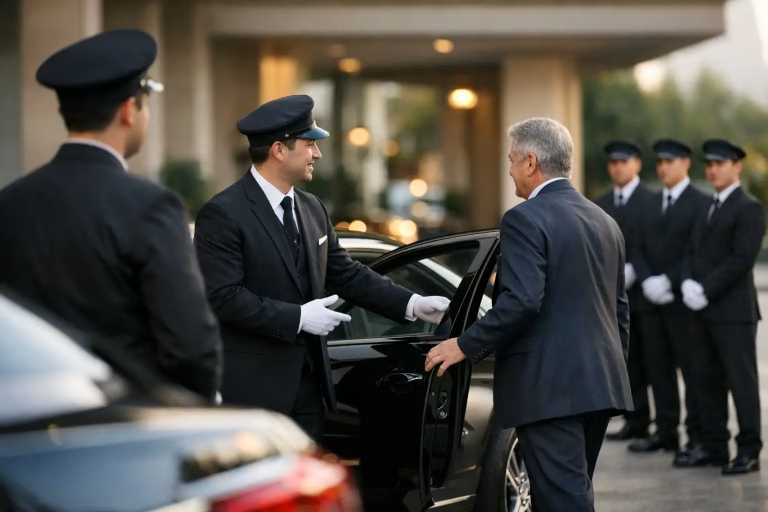

تشغيل صف سيارات للمقار الإدارية باحتراف
A crowded front drive tells visitors something before reception ever does. If executives, clients, and employees arrive to blocked lanes, confused parking flow, and long waits, the building feels harder to trust. That is why تشغيل صف سيارات للمقار الإدارية is not a side service. It is an operational function that shapes first impressions, traffic discipline, and the overall professionalism of the site.
For administrative headquarters, corporate offices, and business campuses, parking is rarely just about empty spaces. It is about managing peaks at the start of the day, protecting access points, keeping drop-off zones clear, and giving VIP guests a polished arrival experience without slowing everyone else down. A well-run valet operation supports the building’s image while reducing pressure on internal facility teams.
Why office valet operations matter more than they seem
In an administrative setting, arrival patterns are predictable in one sense and volatile in another. You may know when the morning rush starts, but you cannot always predict a board meeting, vendor delivery conflict, or a cluster of external visitors arriving at the same time. When parking is left unmanaged, those moments create visible friction.
A professional valet setup helps absorb that pressure. It creates a controlled handoff point between the public curb and the internal workplace. Employees are not asked to solve parking disputes. Security is not pulled into directing cars unless necessary. Reception can stay focused on guests instead of apologizing for congestion outside.
There is also a brand dimension that many office operators underestimate. In hospitality, the arrival experience is obviously important. In corporate environments, it matters just as much, especially when the building hosts investors, government delegates, senior clients, or job candidates. A composed and courteous valet team signals discipline. Disorder at the entrance signals the opposite.
What تشغيل صف سيارات للمقار الإدارية actually includes
The strongest valet programs for administrative sites are built as operating systems, not just staffing arrangements. That distinction matters. Sending attendants to the curb may cover the immediate need, but it does not solve movement flow, vehicle storage strategy, guest prioritization, or risk control.
A proper office valet operation usually starts with site planning. The team studies entry and exit lanes, available stacking space, handoff points, pedestrian paths, and nearby parking inventory. From there, the process is shaped around the building’s traffic reality. Some sites need fast turnover for short meetings. Others need full-day vehicle storage with careful retrieval timing around lunch and end-of-day peaks.
The service also depends on trained staff behavior. In an office setting, courtesy must be matched with discretion. Drivers and guests expect efficiency, but they also expect professionalism in communication, handling, and appearance. This is especially true in executive locations where the valet team becomes part of the front-of-house identity of the property.
Technology often plays a practical role as well. Digital ticketing, vehicle tracking, and organized dispatch reduce retrieval delays and minimize handoff errors. The benefit is not just speed. It is accountability. When a facility manager wants fewer complaints and cleaner reporting, structured tools matter.
The operating model should match the building, not the other way around
One mistake many organizations make is assuming every office valet service should look the same. It should not. A headquarters with a formal executive entrance has different needs from a shared office complex with high visitor turnover. A medical administrative center with steady daytime traffic needs a different cadence than a corporate tower that spikes around scheduled meetings.
That is why the right model depends on several factors. The first is traffic density at specific times, not just total daily volume. Fifty vehicles arriving in ten minutes create a very different requirement from the same number arriving over an hour. The second is parking geography. If the storage area is remote, retrieval planning becomes more critical. The third is guest mix. Employee-heavy patterns behave differently from sites that receive external visitors throughout the day.
Some locations only need valet support during peak hours or executive events. Others need full daily operation with fixed staffing, supervisory oversight, and live capacity management. There is no advantage in overbuilding the service, but there is also no benefit in underestimating demand and forcing the front entrance to absorb recurring strain.
What decision-makers should evaluate before outsourcing
If you are responsible for facilities, operations, or guest experience, the question is not simply whether valet is needed. The better question is what problem the service is expected to solve.
For some properties, the answer is congestion relief. For others, it is image protection. In some cases, it is security and control over who parks where. In others, it is the need to host senior guests without disrupting normal access. A clear objective leads to a better operating plan and a more realistic staffing model.
It is also worth looking closely at liability and process discipline. A professional provider should work with defined vehicle intake procedures, driver protocols, routing rules, and insurance coverage while vehicles are under care. These details are not decorative. They are the difference between a premium service and a risky convenience.
Training is another area where quality becomes visible quickly. Office environments require calm under pressure, accurate communication, and polished guest interaction. The team must know how to handle congestion without appearing rushed, and how to maintain service standards during routine periods as well as high-pressure windows.
Common pain points in office sites and how valet fixes them
Most administrative buildings struggle with the same set of parking issues. The entrance lane gets blocked by short-term stops. Visitor parking fills unpredictably. VIP arrivals conflict with employee traffic. At the end of the day, retrieval demand clusters into a narrow window and delays start compounding.
A structured valet operation addresses these issues through active control. Vehicles are received in an organized sequence. Parking capacity is managed dynamically rather than guessed at. Priority handling can be given to executives, special guests, or pre-registered visitors without creating visible disorder. Retrieval timing can be staggered or pre-coordinated when the site has known meeting schedules.
This does not mean valet solves every parking problem automatically. If the building has severely limited parking inventory, the operator still needs a realistic overflow plan. If access roads are constrained, lane design and curbside discipline become essential. Good execution improves the system, but it cannot replace basic site constraints. The value lies in managing those constraints with professionalism rather than letting them define the guest experience.
Service quality shows up in small moments
In office environments, people often notice the details more than the operation itself. Was the entrance clear at 8:15 a.m.? Did a client wait too long in the sun? Was a senior guest greeted promptly and directed confidently? Did vehicle retrieval feel orderly at 5:30 p.m.?
These moments shape perception because they happen at transition points. People are arriving for work, stepping into meetings, or leaving after a long day. A disciplined valet team reduces friction when tolerance is low and expectations are high.
That is also why appearance, tone, and timing matter. Staff uniforms, greeting etiquette, ticket handling, and lane positioning all contribute to whether the service feels premium or improvised. The best providers understand that they are not only moving vehicles. They are protecting the image of the property at its most visible touchpoint.
تشغيل صف سيارات للمقار الإدارية as a long-term operational decision
For many organizations, valet starts as a reaction to a parking issue. Over time, it becomes part of how the site functions. That shift is usually a sign that the service is doing more than absorbing overflow. It is improving order, reducing internal distractions, and giving the building a more controlled arrival experience.
In Saudi business environments, where hospitality standards and executive expectations continue to rise, this matters even more. Administrative sites are expected to balance efficiency with courtesy. That balance is difficult to maintain when parking operations are informal or handed off to untrained personnel.
A specialized provider can bring structure, supervision, and service discipline that most internal teams are not built to maintain on their own. That is where a company like Wagifli fits best – not as extra manpower at the curb, but as an operating partner that understands both vehicle flow and guest-facing service.
If your entrance is regularly under pressure, the right question is not whether people can still find a place to park. It is whether the way they arrive reflects the standard your organization wants to present.