
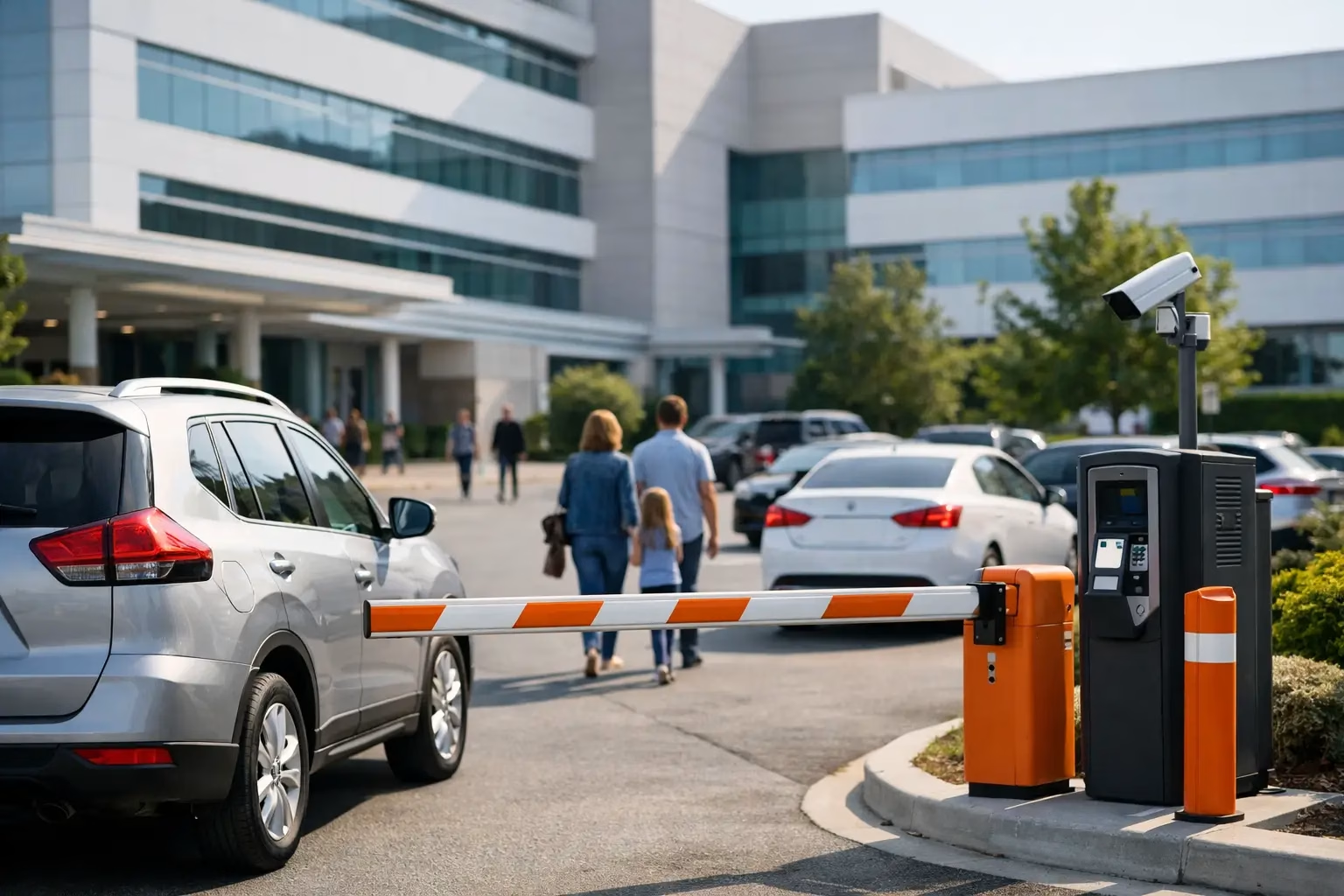
How Hospitals Handle Visitor Parking Well
A visitor arriving at a hospital is rarely thinking about parking first. They may be supporting a family member, coming to an urgent appointment, or carrying a child through a busy entrance. Yet how hospitals handle visitor parking shapes the first minutes of that experience. A confusing lot, blocked drop-off lane, or long walk can add stress before the visitor reaches reception.
For hospital leadership, visitor parking is not simply a facilities issue. It is an operational and hospitality responsibility that affects safety, access, traffic flow, staff productivity, and the public perception of care. The strongest approach combines clear policies, thoughtful site design, trained personnel, and the ability to adapt when demand changes by the hour.
How hospitals handle visitor parking under pressure
Hospital parking demand is unpredictable because hospital activity is unpredictable. Scheduled clinic visits create one pattern, while emergency arrivals, visiting hours, shift changes, and major procedures create others. A plan that works at 10 a.m. may fail during the late-afternoon visitor rush.
Effective hospitals begin by separating the needs of different users. Emergency patients need an unobstructed path to the emergency department. Patients with limited mobility need spaces close to the correct entrance. Staff need dependable parking that does not compete with visitor access. Visitors need a simple route, clear guidance, and an arrival process that respects the circumstances bringing them to the facility.
This often means assigning parking zones rather than treating every space as interchangeable. Short-stay visitor spaces may sit closest to the main entrance, while longer-stay parking is directed to more distant lots or garages. Reserved spaces for accessibility, maternity, dialysis, oncology, physicians, and operational vehicles should be visible and protected from misuse. The exact layout depends on the campus footprint, but the principle stays the same: place each vehicle group where it causes the least conflict.
The entrance is a working zone, not a waiting area
Hospital entrances frequently become congested when drivers stop to unload passengers, wait for relatives, ask for directions, or search for a space. Without active management, a curbside drop-off lane can quickly turn into a queue that blocks ambulances, shuttles, and other arrivals.
A well-run arrival zone has clear lane markings, posted time limits, visible signs, and staff who can guide drivers with calm authority. The goal is not to move people along abruptly. It is to help them reach the right entrance safely while keeping the roadway open for the next vehicle.
This is where trained valet attendants or traffic marshals can make a measurable difference. They can receive a vehicle, assist a guest who needs extra time, direct family members to the correct building, and keep the curb moving. In a healthcare setting, that service must be delivered with discretion. Speed matters, but empathy and professionalism matter just as much.
Parking policies should protect access, not create friction
Visitor parking policies work best when they are easy to understand before a driver enters the property. Confusing signs, unclear payment rules, and inconsistent enforcement create avoidable complaints at a place where people may already be under emotional pressure.
Hospitals typically set rules around visiting hours, time limits, validation, overnight parking, and restricted areas. Those rules are necessary, especially on campuses where space is limited. But they should be designed around real visitor behavior. A family supporting a patient after surgery may need flexibility that a standard two-hour limit cannot provide. A visitor who has been directed to another department should not be penalized because the appointment ran longer than expected.
The practical balance is firm control with a clear exception process. Parking personnel and front-desk teams should know who can authorize an extension, how overnight vehicles are recorded, and what to do when a visitor cannot safely move a vehicle at the stated time. Consistency protects the facility, while reasonable discretion protects the guest experience.
Payment and validation need to be simple
Paid visitor parking can help hospitals manage demand and fund parking operations, but payment should never become a bottleneck at the exit. Cashless payment, ticket validation, license-plate recognition, and prepayment options can reduce queueing when they are supported by clear instructions and staff assistance.
Technology is useful when it solves a specific operational problem. A ticketing system can record vehicle custody for valet service. Occupancy data can help teams redirect arrivals before a garage reaches capacity. Digital signs can show drivers which area has available spaces. Still, technology does not replace an informed person at the entrance when a visitor is confused, distressed, or dealing with an unfamiliar campus.
Accessibility must be built into every parking decision
Accessible parking is more than a compliance requirement. It is a direct part of patient and visitor care. Spaces must be located along usable routes, clearly marked, kept free of obstructions, and monitored so they remain available for the people who need them.
The wider experience also matters. A visitor may have an accessible space but still face a poorly maintained walkway, an unclear route to the elevator, or a long distance to the right entrance. Hospitals should evaluate the complete journey from the parking space to reception, including lighting, curb cuts, crosswalks, weather protection, wheelchairs, and wayfinding.
Valet service can provide additional support for elderly guests, guests with mobility limitations, and parents managing children or medical equipment. This is especially valuable when the closest self-parking spaces are limited. The service should be structured carefully, with trained staff, controlled key handling, documented vehicle condition when appropriate, and insurance coverage while vehicles are in the operator’s care.
Capacity management is a daily discipline
Adding more spaces is not always possible or financially sensible. In many hospitals, the more immediate opportunity is to use existing capacity better. That starts with understanding when and where congestion occurs.
Parking managers should track occupancy by zone, arrival peaks, average parking duration, curbside dwell time, and the frequency of vehicles turned away or redirected. These patterns reveal whether the real problem is insufficient capacity, poor distribution, unclear directions, or slow processing at the entrance and exit.
For example, a full visitor lot may appear to demand a new garage. But if staff vehicles occupy the most convenient spaces during visiting hours, a revised staff parking policy may relieve pressure faster. If drivers circle because they cannot see available spaces, better signage and active guidance may have a greater effect than construction. If the drop-off lane is overloaded for only two hours each afternoon, a targeted valet team during that period can be more efficient than a full-day deployment.
Prepare for surges before they happen
Hospitals need a parking plan for predictable high-volume periods, including holidays, seasonal clinics, major outpatient days, public events, and staffing changes. They also need a response plan for unexpected surges, such as an emergency incident or temporary closure of a nearby parking area.
A surge plan should define who opens overflow parking, who directs traffic, how visitors are informed, and when additional valet or shuttle support is activated. It should also establish escalation points. Waiting until all primary lots are full is often too late. Early action prevents traffic from spilling onto access roads and protects emergency routes.
The role of valet in hospital visitor parking
Hospital valet is not a decorative amenity. When designed properly, it is a capacity and service tool. It can reduce curbside congestion, shorten the distance between the vehicle and entrance, support guests who need assistance, and create a more controlled arrival process during peak periods.
The trade-off is that valet requires disciplined execution. Teams must be trained in safe driving, patient-sensitive communication, traffic direction, key security, vehicle documentation, and emergency procedures. They also need a parking strategy behind the scenes. Receiving vehicles quickly is only useful if attendants can park and retrieve them without creating congestion elsewhere.
A professional partner such as Wagifli can help hospitals build a service model around their actual traffic conditions, rather than applying a generic valet setup. That may include dedicated arrival teams, ticketing tools, parking-zone plans, peak-hour staffing, and reporting that gives management a clearer view of performance.
The most effective visitor parking operation is one visitors barely have to think about. They arrive, receive clear guidance, find the appropriate level of assistance, and enter the hospital feeling expected rather than delayed. That is the standard worth designing for, especially when every minute of calm can matter.