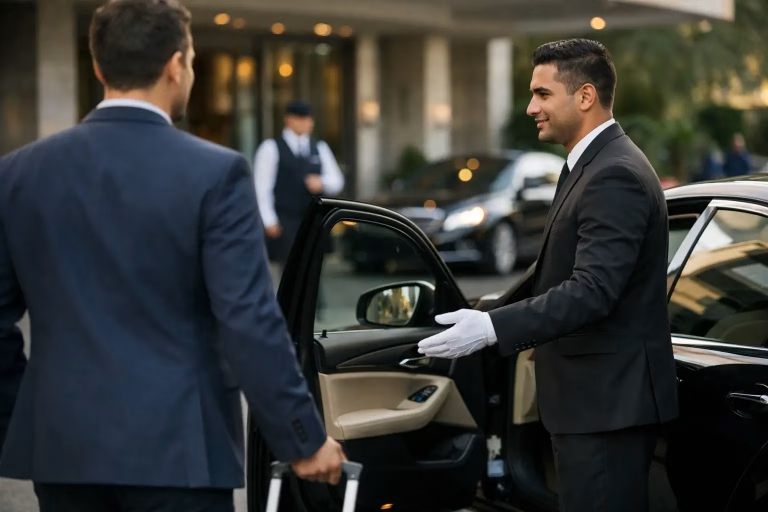

فاليه للمراكز الطبية for Better Patient Arrivals
A patient arriving for an appointment should not have to begin the visit by circling for parking, crossing a busy driveway, or helping an elderly family member navigate a crowded lot. For healthcare facilities, فاليه للمراكز الطبية is not simply a premium convenience. It is an operational service that shapes access, patient comfort, safety, and the first impression of care.
Medical centers operate under a different kind of pressure than hotels, restaurants, or event venues. Visitors may be in pain, anxious about a diagnosis, late for an appointment, carrying medical equipment, or accompanying someone who needs mobility support. A well-managed valet operation gives the facility a controlled, courteous way to receive those visitors from the moment their vehicle reaches the entrance.
Why Arrival Management Matters in Medical Centers
The entrance of a medical center is a high-stakes transition point. Vehicles arrive at uneven intervals, appointments overlap, ambulances or service vehicles may require priority access, and family members often need clear direction. Without active management, the curb can quickly become congested, creating delays that affect both patient experience and clinical schedules.
A professional valet team organizes this movement with purpose. Attendants guide vehicles into the correct drop-off position, maintain access to doors and ramps, assist with the safe transfer of guests when appropriate, and move vehicles efficiently to designated parking areas. The objective is not merely to park cars quickly. It is to keep the arrival zone calm, safe, and respectful.
For an outpatient clinic, this may mean reducing the frustration of a limited parking lot during peak appointment hours. For a specialist center, it may mean giving older patients and their caregivers a more manageable route from vehicle to reception. For a larger medical complex, it may mean preventing curbside congestion from disrupting multiple entrances and departments.
فاليه للمراكز الطبية as Part of Patient Care
Patients often form an opinion about a facility before meeting a physician or checking in at reception. A confusing arrival, an unattended driveway, or a long walk in difficult weather can add stress at the wrong moment. By contrast, a polite, trained attendant who receives the vehicle, provides clear guidance, and treats each guest with discretion communicates that the facility is organized and attentive.
This matters particularly for medical centers serving patients with reduced mobility, chronic conditions, pregnancy-related care needs, or post-treatment limitations. Valet service can reduce unnecessary walking and help families focus on the appointment rather than parking logistics. It should never replace accessibility planning, but it can strengthen it when integrated with accessible drop-off zones, ramps, wheelchairs, and reception procedures.
The service also supports caregivers. Many patients arrive with a spouse, parent, child, or home health assistant. A valet process allows the caregiver to remain with the patient at the entrance while the vehicle is handled professionally, rather than leaving the patient alone to search for a space.
What a Medical Valet Operation Should Include
A successful program begins with a site-specific operating plan. Medical centers vary widely in driveway design, parking capacity, visitor volume, and patient needs. Copying a generic valet setup from another property can create new bottlenecks instead of solving existing ones.
The operating plan should account for arrival peaks, appointment schedules, emergency access routes, staff parking, patient drop-off areas, and vehicle retrieval patterns. It should also establish where vehicles are stored, how keys are secured, and how attendants communicate when demand increases.
The most effective medical valet services generally include four connected elements:
- Trained attendants who understand professional guest service, safe driving practices, privacy expectations, and the importance of respectful communication in a healthcare setting.
- Clear traffic control at the entrance to keep the curb organized and preserve access for emergency vehicles, mobility assistance, and scheduled pickups.
- A controlled ticketing or digital tracking process that records vehicle details and supports accurate, timely retrieval.
- Defined insurance coverage and accountability procedures while vehicles are under the operator’s care.
Technology can improve speed and visibility, but it should support the human operation rather than complicate it. A ticketing process, vehicle log, or digital queue is useful when it reduces retrieval errors and gives supervisors a clear view of demand. At a smaller clinic with predictable traffic, a simple and disciplined system may be more practical than an overly complex platform.
Safety, Privacy, and Trust Cannot Be Treated as Extras
Healthcare visitors are rightly sensitive to trust. They may have personal belongings in their vehicles, may be arriving during emotionally difficult circumstances, or may be concerned about leaving a car with an unfamiliar attendant. The valet provider must answer those concerns through visible standards, not vague assurances.
Professional appearance, identification, courteous language, secure key handling, documented vehicle intake, and insured vehicle custody all contribute to confidence. Attendants should inspect and record relevant vehicle condition according to the agreed process, avoid unnecessary handling of personal belongings, and communicate clearly when a guest has a special request.
Privacy is equally important. A valet team does not need access to patient information to perform well. What it needs is operational discipline: knowing where to direct visitors, recognizing priority drop-off requirements, and avoiding conversations or behavior that could compromise a guest’s dignity.
Facility leadership should also confirm that valet staging does not interfere with emergency lanes, ambulance access, fire routes, or security protocols. In medical settings, faster vehicle movement is valuable only when it remains fully aligned with safety requirements.
Choosing the Right Staffing Model
The right number of attendants depends on more than the size of the parking lot. Decision-makers should consider hourly arrival patterns, average length of stay, number of entrances, driveway capacity, walking distance to the vehicle storage area, and the proportion of guests who need additional assistance.
A center with a concentrated morning rush may need more attendants for a limited period and fewer later in the day. A facility with extended evening clinics may require a staggered schedule. Seasonal changes, visiting specialists, health campaigns, and weekend operations can also alter demand.
This is why a flexible operating model is often preferable to a fixed staffing assumption. The service should be built around actual traffic behavior and adjusted after observation. A provider that monitors arrival volume and retrieval times can identify whether delays are caused by insufficient staff, a poorly defined curb zone, or parking capacity that needs a different allocation.
Measuring the Operational Value
Medical center leadership should evaluate valet service through measurable outcomes as well as guest feedback. Useful indicators include average vehicle retrieval time, curbside queue length, number of parking-related complaints, peak-hour throughput, and adherence to emergency access rules.
The impact can also appear in less obvious areas. Reception teams may spend less time giving parking directions. Security personnel can focus on site safety rather than managing double-parked vehicles. Patients may arrive at check-in calmer and closer to their appointment time. These improvements do not replace quality clinical care, but they remove friction around it.
At facilities where parking is a frequent source of negative feedback, valet service can protect the broader patient experience. The trade-off is that the operation must be planned and supervised carefully. A poorly staffed valet stand or an unclear handoff process can create frustration just as quickly as an unmanaged parking area. Quality depends on training, accountability, and an operating plan that reflects the site.
A Better Standard for the Medical Entrance
For medical centers in Saudi Arabia, the arrival experience should reflect the same care, order, and professionalism expected inside the facility. A managed valet operation brings structure to one of the busiest and most visible parts of the property while giving patients and caregivers a more dignified welcome.
Wagifli approaches medical valet as a hospitality and site-management responsibility, with trained teams, customized traffic plans, insured vehicle care, and disciplined service at every handoff. The right program is not defined by the number of attendants at the curb. It is defined by whether every patient can arrive with less uncertainty and every facility team can operate with greater control.
Before launching or changing a valet program, walk the entrance during the busiest hour and observe what patients actually face. That short assessment often reveals the practical changes that will make the greatest difference.